
Why Montessori-Inspired Classrooms Build Better Problem-Solvers
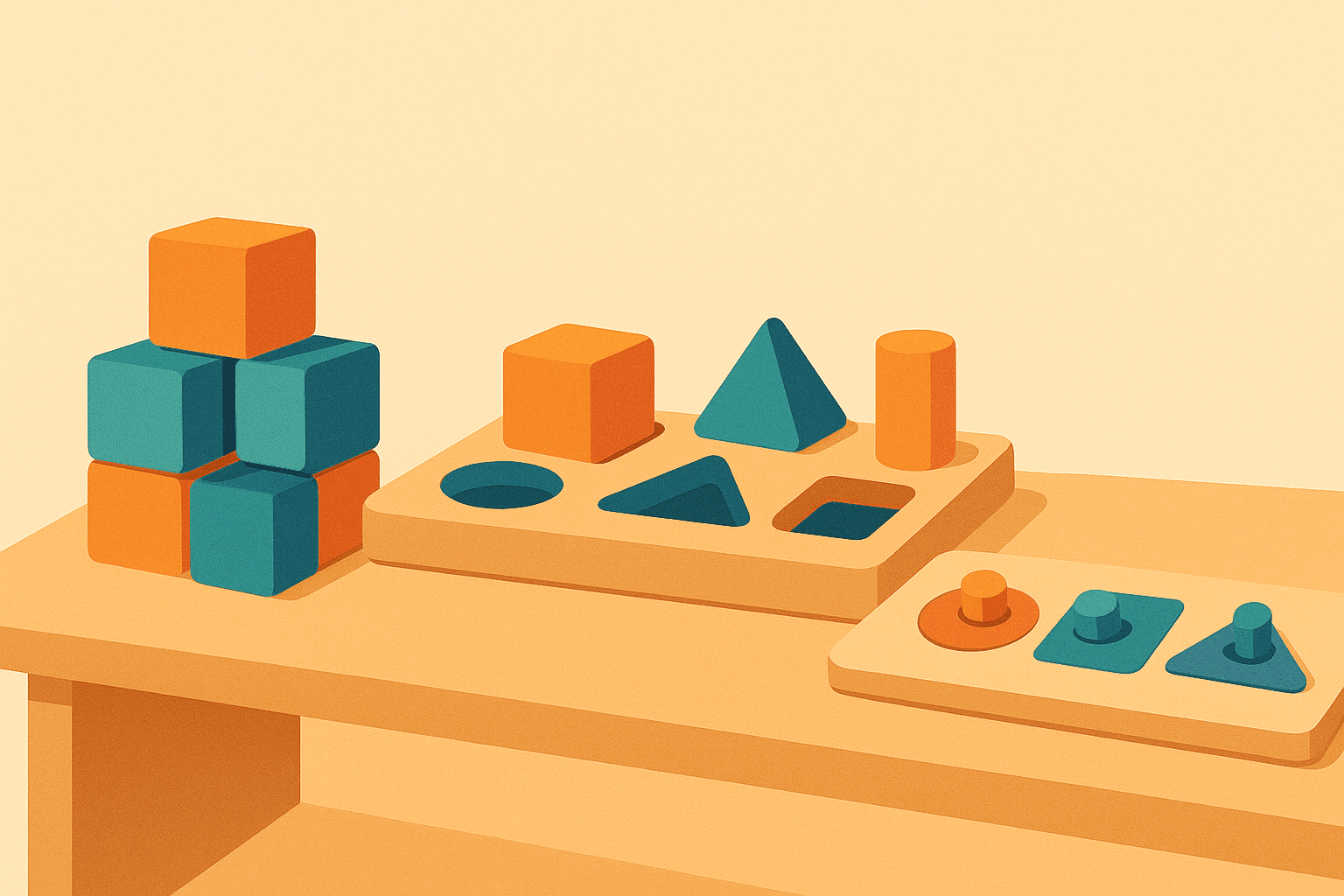
Montessori classrooms often get reduced to an aesthetic — wooden materials, quiet rooms, tidy shelves, a general vibe of calm. It's a look that gets borrowed a lot, sometimes without much of the substance behind it. But the philosophy underneath is a genuinely deliberate approach to how young brains build reasoning skills, developed originally by physician and educator Maria Montessori through close observation of how children actually learn — not how adults assumed they should be taught.
We describe our approach as Montessori-inspired, not Montessori-certified, because we've built our own curriculum around the core ideas that hold up best in a modern classroom. It's worth explaining why those ideas work, not just what the room looks like.
Self-correcting materials teach without a teacher's intervention
Many of the materials in our classrooms are designed so a child can see their own mistake directly — a puzzle piece that doesn't fit, a tower that topples, a pouring exercise that spills because the angle was wrong. That immediate, judgment-free feedback lets children build persistence and problem-solving instincts on their own timeline, rather than waiting for an adult to point out what went wrong.
There's a real difference between a child who solves a problem because a teacher corrected them and a child who solves it because the material itself showed them the answer. The second version builds a kind of quiet confidence — "I can figure this out" — that shows up again and again once children move on to harder material, including academic work that has nothing to do with blocks or puzzles.
Choice builds focus
When children choose their own activity from a set of purposeful options, they tend to engage longer and more deeply than when an activity is assigned to them. That sustained focus — sometimes called "Montessori concentration" — is a skill that transfers directly to reading, math, and later academic work, where the ability to stay with a hard problem instead of bailing at the first sign of difficulty matters enormously.
In practice, this looks like a child spending twenty uninterrupted minutes with a shape-sorting board, trying it three or four different ways before it clicks — instead of being redirected to the next station on a fixed schedule the moment the clock says so. That length of engagement is rare to see in a toddler or preschooler, and it's not an accident. It's what happens when a child is genuinely interested rather than simply compliant.
It's not unstructured — it's differently structured
A common misconception is that child-led learning means no structure, or that kids are just left to wander. In practice, our Montessori-inspired classrooms are carefully designed environments: materials are sequenced by difficulty, everything has a specific place it returns to, and teachers observe closely to introduce the next challenge at exactly the right moment for each child — not too early, when it would just be frustrating, and not too late, when it would be boring.
That takes more teacher skill, not less. A traditional lesson plan is the same for every child in the room on a given day. Matching each child to the right next step, continuously, requires teachers who genuinely know each individual child — which is part of why we keep our classrooms small and our ratios low.
What this looks like at different ages
In our Early Learners classroom (ages 1–2), this shows up as low, reachable shelves with simple sensory materials — stacking, sorting, pouring — that build fine motor control and the earliest sense of cause and effect.
In Preschool (ages 3–4), the materials get more sophisticated: shape and pattern work, practical life activities like pouring and buttoning, and early literacy materials that let children feel letter shapes before they're expected to write them.
By Pre-K (ages 4–5), the same underlying philosophy supports more structured academic content — guided reading groups, hands-on math manipulatives, early writing — layered on top of the independence and focus the earlier years built. It's less a hard switch to "real school" and more a continuation of habits your child has already been practicing for years.
"But will they be ready for a traditional kindergarten classroom?"
This is the question we hear most often, and it's a fair one. The honest answer: yes, and often more ready than peers who spent their early years in a purely worksheet-driven environment — because kindergarten actually asks for exactly what Montessori-inspired classrooms build. Following multi-step directions, working independently, managing frustration, and genuine curiosity about how things work.
Our Pre-K program is explicitly aligned to Louisiana kindergarten-readiness benchmarks in literacy, math, and science, precisely because we want the transition to feel like a natural next step, not a jarring change in expectations. Children leave us not just academically prepared, but with the habits of mind — focus, independence, resilience with hard problems — that make the rest of school easier.
The long-term payoff
Children who spend their early years in hands-on, child-led environments often carry forward a genuine comfort with open-ended problems — the kind that don't have a single correct worksheet answer, which describes most of the interesting problems they'll encounter for the rest of their lives. That's a skill set that matters well beyond kindergarten, and it's the whole reason we build our classrooms this way instead of taking the simpler, more traditional route.
Written by The Village of Learning Team

Let's find the right classroom for your child.
Tours are free, unhurried, and the best way to see if The Village of Learning feels like home. Spots fill quickly — reach out today.
Or call us at (225) 390-1136